Every Q4, someone asks the same question the wrong way:
“Should we build this in-house or bring in help?”
It sounds like a knowledge gap. It isn’t.
“Most IT leaders understand when it makes sense to hire a full-time employee versus a contractor,” says Sarah Pervo, Chief Revenue Officer at Artemis. “I haven’t seen a time where that mistake happens. What we usually see is that full-time hires take time. It’s a lengthy process. Contractors are a quick way to bring in talent and start solving problems.”
So if IT leaders already know the difference, why does this decision still eat up so much of Q4 planning? Because build vs. buy vs. staff was never really the hard part.
The hard part is knowing which stage your initiative is actually in, and stage, not preference, is what should be driving the call.
(If you’re not yet sure this is even a staffing question, start here. This post assumes you’ve already cleared that hurdle.)
This isn’t a “which one is best” post. Build, buy, and staff are all correct answers for different problems, at different points in an initiative’s life. Here’s how to figure out which one you’re actually solving for.
Build, Buy, Staff: What Each Option Actually Means
Before comparing them, it’s worth being precise about what each term covers, because IT leaders often mean different things by the same word.
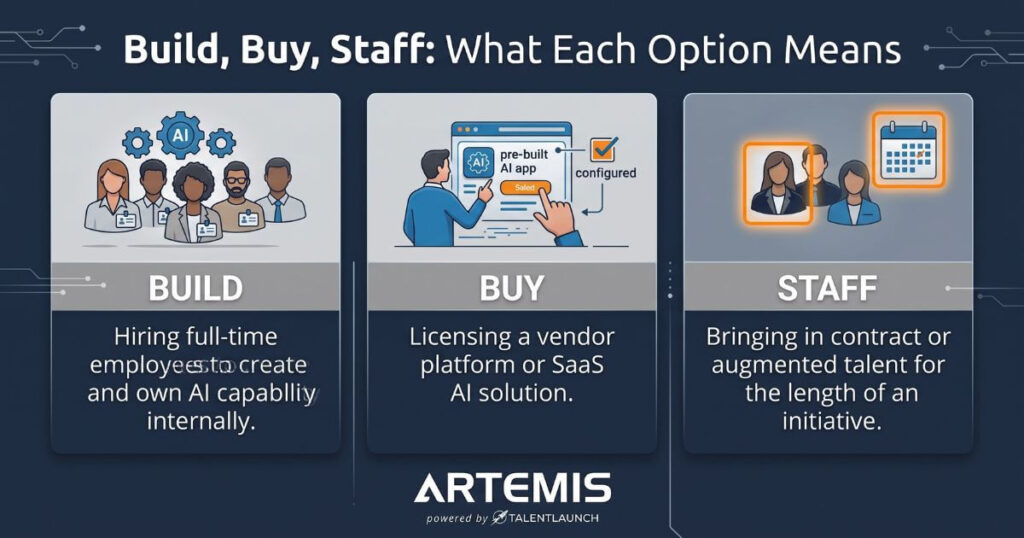
Build means hiring full-time employees to create and own AI capability internally: data scientists, ML engineers, or AI-focused software engineers who join your headcount and stay past the current project.
Buy means licensing a vendor platform or SaaS AI solution: Think a pre-built model, an AI feature bolted onto existing software, or a managed AI service — and configuring it rather than building the underlying technology yourself.
Staff means bringing in contract or augmented talent: specialists who join your team for the length of an initiative to execute a specific scope, then roll off once the work is done or gets absorbed by your internal team.
None of these is inherently cheaper, faster, or safer.
Each one shifts risk to a different place: build shifts risk to your hiring timeline and retention, buy shifts risk to vendor lock-in and fit, staff shifts risk to knowledge transfer and internal ownership.
The right call depends on where your initiative actually sits.
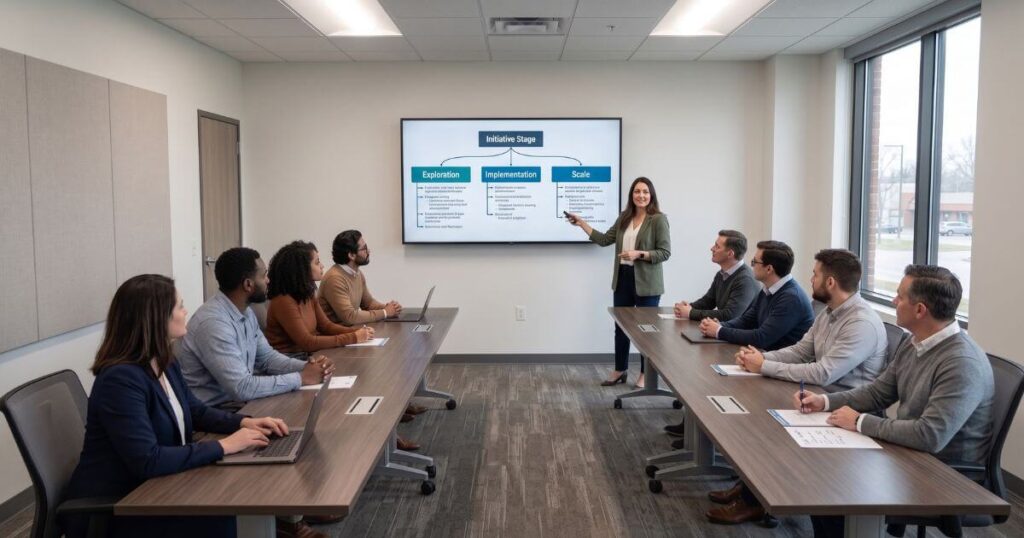
The Real Question: What Stage Is This Initiative In?
This is the framework that matters more than any cost comparison. Most build-vs-buy-vs-staff decisions go wrong because they’re made at the wrong stage, not because the wrong option was picked in the abstract.
Exploration Stage
You don’t know yet if this use case is worth pursuing. You’re testing a hypothesis, not committing to a roadmap.
- Right move: Buy a vendor tool to test the concept cheaply, or staff a short-term specialist to build a proof of concept. Building full-time headcount here is premature because you’d be hiring before you know what the job actually is.
- Wrong move: Posting a full-time AI engineer role before anyone has validated the use case. You’ll either hire the wrong profile or have an expensive employee with nothing defined to do six months in.
Implementation Stage
The use case is validated. Now someone has to actually build, integrate, and ship it.
- Right move: This is usually where IT staff augmentation earns its place. Sarah points to a specific pattern here: large organizations running an ERP, cloud, or broader digital transformation initiative — or working through M&A activity — consistently need contract support at this stage.
These projects typically run one to three years and require specialized skills the team won’t need once the platform is live. That’s the clearest signal for staff over build: the skill is real, but it isn’t permanent. It’s also where “buy” gets tested for real: does the vendor platform actually integrate with your legacy ERP or CRM, or does it need custom development to make it work?
- Wrong move: Assuming the vendor platform’s marketing demo is the same thing as production-ready integration with your systems. Budget for the possibility that “buy” needs staffing support to actually land — treating the platform purchase as the finish line is usually premature.
Scale Stage
The initiative works, it’s proven value, and now it’s becoming a permanent part of how the business operates.
- Right move: This is when build makes sense. The capability needs a permanent owner, institutional knowledge, and continuity that a single project doesn’t require. Full-time hiring is justified because there’s now an ongoing job, not a finite scope.
Here’s what that team actually needs to look like once you’re building it.
- Wrong move: Continuing to staff a rotating cast of contractors for something that’s become core infrastructure. At scale, the hidden cost of not having a permanent owner — inconsistent decisions, no accountability when something breaks — outweighs the flexibility contract talent offered earlier.
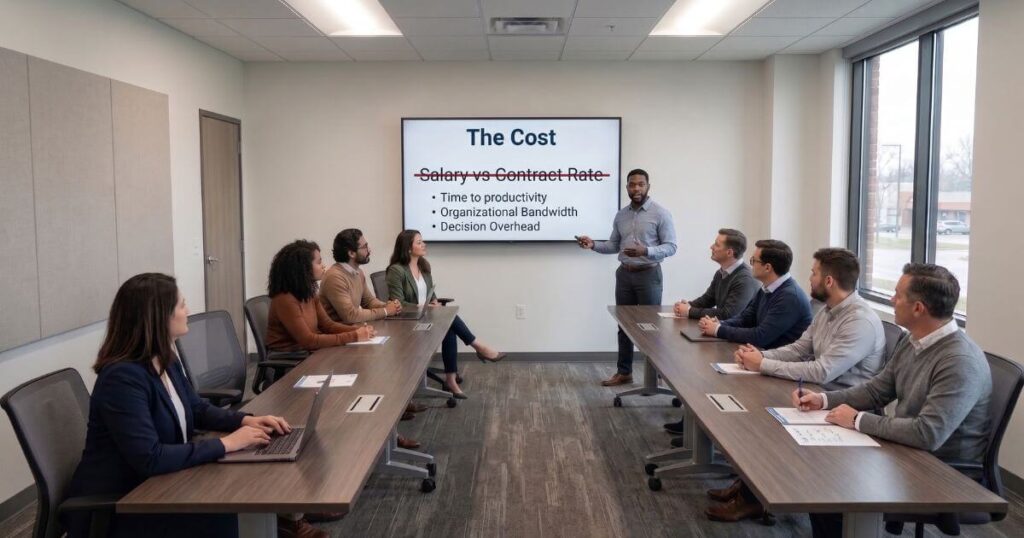
What Each Option Costs
Salary versus contract rate is the comparison everyone runs first, and it’s the least useful one. The real cost differences show up in three places that don’t show up on a rate card.
Time to productivity
A full-time hire needs weeks to ramp on your systems, your data, and your org chart before they’re producing anything. A contract specialist who’s done this exact type of engagement before is often productive within days.
Organizational bandwidth
Buying a platform sounds like it removes staffing risk entirely. It doesn’t. Rather, it converts staffing risk into internal bandwidth risk. Someone on your team still has to manage the vendor relationship, own the configuration, and troubleshoot when the “it just works” promise doesn’t survive contact with your actual environment.
Decision-making overhead
Build decisions are the slowest to reverse. A bad full-time hire, or a validated use case that turns out not to scale the way you expected, takes months to unwind — performance management, backfilling, sometimes both.
Staff augmentation sets a different expectation from day one: once the project wraps, the specialist moves on to their next engagement. That’s built into the arrangement, not a surprise either side has to navigate.
None of this means contract talent is cheaper in some universal sense. It means the sticker price on any of these three options is not the number that determines whether the decision was a good one.
Where Each Approach Breaks Down
Every option fails the same way: when it’s applied at the wrong stage, or held onto past the point where it stopped being the right fit.
Build breaks down when it happens too early, and the risk isn’t that leaders don’t know the difference between hiring and contracting. By Sarah’s account, most do.
It’s timeline. Full-time hiring is a lengthy process by design — sourcing, interviewing, offers, notice periods — and that process doesn’t move faster just because an AI initiative wants to.
Committing to a full-time search before a use case is validated means running a slow process against a fast-moving decision. Add in that AI-specific full-time talent is scarce enough already, and backing out of a bad hire once you’ve made it is expensive on top of slow.
Buy breaks down when the platform’s fit assumptions don’t match your actual environment. A vendor demo rarely accounts for a decade of legacy ERP customization or a data environment nobody’s fully documented. The platform gets purchased, and then the real work (the integration nobody scoped for) has nowhere to live.
Staff breaks down when it’s used to avoid a build decision indefinitely. Contract talent is excellent at executing a defined scope, but it’s a poor substitute for an owner when a capability has become permanent.
If you’re on your fourth consecutive contract engagement doing essentially the same work with no plan to bring it in-house, that’s not staffing agility. It’s a build decision you’re avoiding.
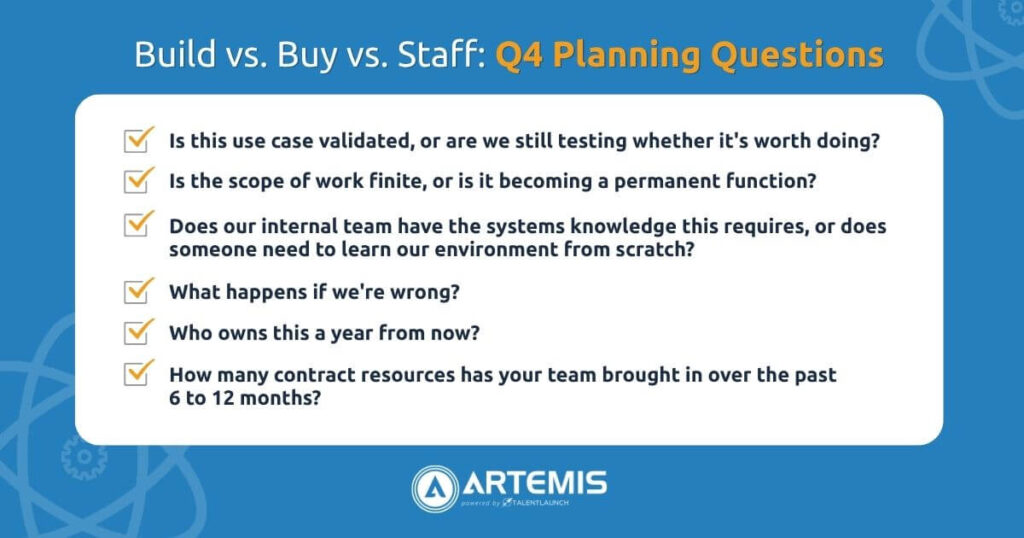
How to Run This Decision in Your Q4 Planning Conversations
A few questions, asked in this order, do more work than any cost spreadsheet:
1. Is this use case validated, or are we still testing whether it’s worth doing? If you can’t answer this with confidence, you’re in exploration. Don’t build yet.
2. Is the scope of work finite, or is it becoming a permanent function? Finite work points toward staff or buy. Permanent function points toward build.
3. Does our internal team have the systems knowledge this requires, or does someone need to learn our environment from scratch? This determines whether “buy” alone will actually work, or whether it needs staffing support to integrate.
4. What happens if we’re wrong? How expensive and how fast is it to reverse a build hire versus a vendor contract versus a staffing engagement? Weight your decision toward whichever option is cheapest to unwind if the initiative doesn’t pan out.
5. Who owns this a year from now? If nobody can answer that question, you’re not ready to build, and you’re probably not ready to stop staffing it either.
6. Look at your own contracting history first. How many contract resources has your team brought in over the past 6 to 12 months? Why — a skill gap, or a project push? Sarah says this is usually the first question she asks a new client, before AI ever comes up. The pattern in your own recent hiring often answers the build-buy-staff question before any framework does.
Build vs. Buy vs. Staff FAQ
Should I hire AI engineers full-time or bring in contract talent?
It depends on whether the work is finite or ongoing. If the initiative is still being scoped or validated, contract talent lets you move without a long-term headcount commitment. Once the capability becomes a permanent part of how the business runs, a full-time hire is usually the better long-term owner. If you’re leaning toward full-time, here’s how to vet for the profile that’s genuinely hard to fake right now.
When does buying a vendor AI platform make more sense than staffing?
Buying makes sense when the problem you’re solving is common enough that a vendor has already built a good solution for it, and your environment doesn’t require heavy custom integration. It makes less sense when your systems are complex enough that “configuring the platform” turns into a project of its own. That’s usually when buy needs staffing support behind it.
How do I know if I need contract talent for my AI initiative?
Contract talent tends to be the right call at the implementation stage, after a use case is validated but before it’s a permanent function — especially when the work requires specialized skills your internal team doesn’t have and won’t need indefinitely. If you’re weighing this option, staff augmentation is worth exploring in more depth.
What’s the difference between staff augmentation and managed services?
Staff augmentation adds specialists to your team who work under your direction and processes. You retain ownership of the outcome. Managed services hand off ownership of an outcome to a third party that runs it independently.
Most AI initiatives at the implementation stage benefit from bringing in contract staff, because the goal is usually to build internal capability alongside the work, not outsource it entirely.
Wherever You Land, the Stage Matters More Than the Label
Build, buy, and staff aren’t competing philosophies. They’re tools that fit different moments in an AI initiative’s life. The mistake isn’t picking the “wrong” one. It’s picking based on what worked for someone else’s Q3, instead of where your own initiative actually stands right now.
If you’re heading into Q4 planning still sorting out which stage you’re in — or you’ve landed on contract IT staffing as part of the answer — talk to us about your AI initiative.
We’ll help you figure out what stage you’re actually solving for.