
Most companies trying to build an AI team right now aren’t building one. They’re hiring a vendor.
That’s the actual starting point for most organizations today, whether anyone’s said it out loud or not. A platform partner comes in, stands up the initial AI capability, and moves on to the next client.
What they leave behind isn’t a finished internal team. It’s a foundation, and a business that’s just starting to figure out what it needs to own, extend, or fix once the vendor’s gone.
That handoff point is where this article actually starts. Not “here’s the blueprint for building an AI-native team from scratch,” because almost nobody’s doing that yet.
So instead, let’s talk about what comes after the rollout. That’s where organizations usually discover what they actually need to own, extend, or hire for.
If your team already has the AI tools live and the real gap is adoption rather than engineering structure, that’s a different problem worth diagnosing first.
“This is going to be the strategy most companies go with first: bring in a vendor who already has the playbook, rather than build the team from scratch. We see the same thing happen during large ERP implementations.”
— Sarah Pervo, Chief Revenue Officer, Artemis
What AI-Native Means
An AI-native engineering team isn’t defined by the tools it uses. It’s defined by how it’s structured to work alongside AI, not just deploy it.
Teams aren’t just using AI tools. They’re deciding where AI should work independently, where people need to stay involved, and who’s accountable for the results.
The shift is from writing every line of code to deciding what AI should handle, what people should handle, and who’s accountable for the handoff.
That distinction matters more than it sounds like it should, because it changes who you need on the team and when.

The Roles That Make Up an AI-Native Team
Here’s the part that tends to surprise people: most of the roles on an AI-native team aren’t new. They’re roles Artemis has been placing for years, doing a new kind of work.
Artemis isn’t built around high-volume recruiting. We typically make somewhere between 10 and 20 placements a year because these searches require depth, not speed.
Even at that scale, we’ve placed more than 30 professionals across Architect, Engineer, DevOps, and QA roles. Titles and responsibilities shift from company to company, which makes it genuinely hard to draw a clean line between “new AI role” and “existing role, relabeled.”
Most of the time, it’s less of a new job title and more of an existing role absorbing new responsibility.
What tends to actually be new, rather than relabeled, are two things:
- Someone architecting the handoff between human engineers and AI agents. Not just implementing AI tools, but deciding where the agent’s judgment ends and a person’s begins.
- Someone accountable for whether the AI’s output can be trusted before it ships. Traditional QA assumes a human wrote the code. This role exists because that assumption no longer holds.
The titles are still evolving, but the underlying responsibilities are becoming much easier to recognize.
Everything else on the roster is a role your organization likely already has. The work is changing far faster than the org chart.
| Traditional Software Team | AI-Native Engineering Team |
|---|---|
| Data Engineer — builds and maintains data pipelines | Data Engineer — same pipelines, plus curating and maintaining training and evaluation datasets |
| DevOps Engineer — manages deployment infrastructure | AI Platform/DevOps Engineer — same infrastructure, plus model deployment, inference costs, and monitoring |
| QA Engineer — tests human-written code | Eval & QA Engineer — validates AI-generated output, including cases no human wrote or reviewed line by line |
| Software Engineer — builds features | Technical Product Builder — builds features, and decides where a feature should route to an AI agent instead |
| No direct equivalent | Agentic/AI Architect — designs the boundary between what the AI decides on its own and what gets escalated to a person |
| No direct equivalent | Human-in-the-Loop Owner — explicitly accountable for AI output before it ships, closing the gap traditional QA wasn’t built for |
Once you know which of these roles you’re actually missing, the harder part is vetting for them, especially the net-new ones. Screening for a real agentic AI architect looks different than screening a traditional engineer, and most job descriptions for the role haven’t caught up yet.

Build vs. Borrow: Reskill, Contract, or Both
The next question is whether to build your needed roles internally or bring in outside help.
Here, the honest answer is that it’s genuinely too early to name a clear winner, and anyone telling you otherwise is making a bet rather than sharing best practice.
“We’re not seeing a clear winner yet between reskilling internal teams and bringing in outside specialists. It really depends on the client, the role, and what they’re actually trying to accomplish.”
— Sarah Pervo, Chief Revenue Officer, Artemis
That said, three patterns are showing up often enough to be useful:
- When a SaaS or platform vendor is already supporting the AI technology, upskilling internal staff often doesn’t make sense. The vendor owns that layer.
- When leadership wants the team to actually own the technology long-term, upskilling existing engineers is the more common path.
- In some cases, companies are eliminating roles outright based on what the AI can now handle on its own, rather than staffing around it.
None of these are universally right. Which one fits depends on whether you’re trying to move fast, own the capability long-term, or reduce headcount — three very different goals that get lumped together under “build an AI team” more often than they should.
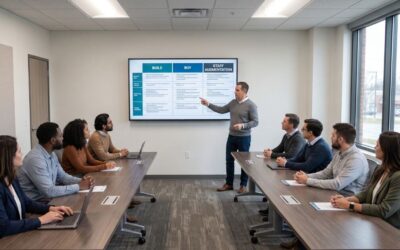
If you’re trying to sort out which of those goals actually applies to you, this build-vs-buy-vs-staff framework walks through it stage by stage.
For most organizations still figuring out which path fits, bringing in contract specialists through IT staff augmentation is the lower-risk way to test a role before committing a full-time salary to it.

Sequencing: What 30 Years of ERP Builds Taught Us About Getting This Wrong
There isn’t enough AI-specific staffing history yet to say with confidence “staff role X before role Y, every time.” Nobody has that data, including us.
AI may be new. Large-scale technology change isn’t.
There’s a closer parallel worth borrowing from: the same structural mistakes that sink ERP implementations tend to sink team builds for any major platform shift, and AI is shaping up to be no exception.
“We’ve seen this movie before with ERP. Companies staff for the initial rollout, and then get caught flat when the real work — the enhancements, the fixes, the stuff nobody planned for — shows up six months later with nobody assigned to it. I’d expect the same pattern with AI.”
— Sarah Pervo, Chief Revenue Officer, Artemis
The lesson that transfers directly: don’t staff only for the initial build.
The vendor-led AI rollout is the easy part to plan for. The harder, less visible staffing need shows up afterward, when your business discovers what it actually wants to own, extend, or fix. And that’s usually the point where the team either gets structured properly or doesn’t.
Plan for that second wave of staffing from day one, instead of treating it as a surprise when it arrives.
The organizations that adapt fastest probably won’t be the ones that predict every AI role perfectly. They’ll be the ones that recognize when the work changes and adjust their teams before the gaps become expensive.
That’s the conversation we’re having with engineering leaders today. Not how to build an AI-native organization overnight, but how to make smarter AI staffing decisions as that organization takes shape.
AI-Native Team FAQs
What is an AI-native engineering team?
An AI-native engineering team is structured to supervise, govern, and orchestrate AI systems alongside human engineers, not just use AI as another tool in the stack. The distinguishing feature isn’t the technology — it’s whether someone on the team explicitly owns the handoff between human and AI work, and whether someone is explicitly accountable for validating AI-generated output before it ships.
How is an AI-native team different from a traditional software team?
The roles look similar on paper: data engineers, platform engineers, QA. But the difference is in ownership. A traditional team assumes a human is accountable for every line of output. An AI-native team has to explicitly assign who’s accountable when an agent produced the work instead. Skip that ownership, and you end up with powerful technology but no clear accountability when something goes wrong.
What roles do you need on an AI team?
Less than you’d think, in terms of brand-new job titles. Most of the roles on an AI-native team already exist in a traditional engineering org (data engineers, platform/DevOps engineers, QA), they’re just being asked to work differently. What’s typically new is one or two roles: someone architecting how work moves between human engineers and AI agents, and someone accountable for whether an agent’s output can be trusted before it ships.
Should I hire or contract AI engineers when building a team?
Depends on the role and the stage. Early on, while you’re still figuring out which roles you actually need, contract makes more sense because it lets you test what the role requires before committing a full-time salary to today’s version of it. Once the shape of the team is clear, some of those roles are worth bringing in-house. A third path that’s working for some organizations: cross-train existing engineers into new AI-native functions while bringing in outside specialists only for the piece nobody in-house can do yet.